
Fire Safety on Board: Fire Extinguishers and Protection Systems
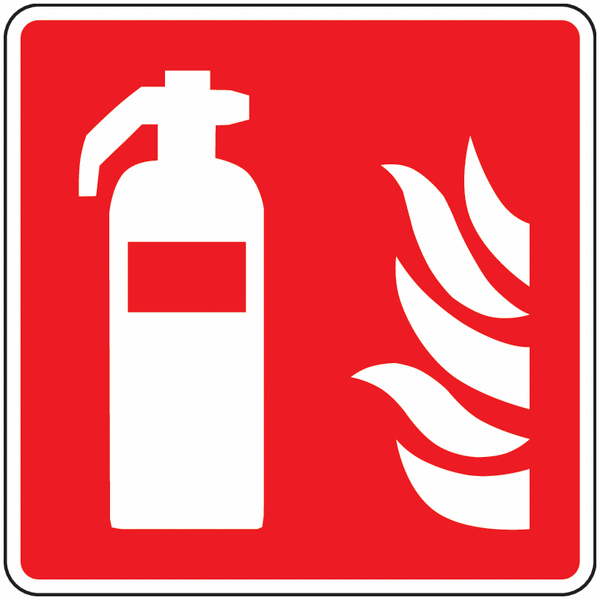
Fire on board is one of the most feared emergencies in navigation. A boat is a complex environment where fuel, electricity, synthetic materials, and often confined spaces coexist. In these conditions, a fire can develop rapidly and become difficult to control.
Fire safety does not depend only on the presence of extinguishers but on a combination of prevention, correct choice of devices, and proper organization of onboard spaces.
The Fundamental Principle: Prevent Before Extinguishing
Most onboard fires originate from avoidable causes.
The most common situations include:
Short circuits or electrical system problems
Fuel leaks or flammable vapors
Overheating of engines or mechanical components
Improper use of kitchens and gas equipment
Accumulation of easily combustible materials
Regular maintenance significantly reduces the probability of an emergency.
Portable Fire Extinguishers: The First Line of Defense
Portable fire extinguishers are the most common and immediately available safety tool on board.
Their effectiveness depends on three factors:
Type of extinguisher
Strategic positioning
Crew’s ability to use them correctly
Extinguishers must be easily accessible and not hidden behind furniture or equipment.
In case of fire, reaction must be quick: every second counts.
Choosing the Right Extinguishing System
Not all extinguishers are the same.
Three main technologies are commonly used on board.
Powder Extinguishers
They are versatile and suitable for different fire types, including electrical and solid fuel fires.
They are widely used because they offer broad protection.
However, they leave residues that may damage electronics and delicate surfaces.
CO₂ Extinguishers
Carbon dioxide extinguishers are particularly effective for:
Electrical fires
Fires near engines or electrical panels
Flammable liquids
They leave no residue and are therefore preferred in areas containing sensitive electronics.
It is important to remember that CO₂ reduces oxygen: the area must be evacuated before activation in closed spaces.
Inert Gas Systems for Advanced Protection
Modern boats can be equipped with automatic systems that release inert gases to suppress combustion.
These systems are also designed to protect onboard electronics.
They are especially useful in engine rooms of larger vessels.
Strategic Placement of Safety Devices
Having extinguishers on board is not enough: they must be positioned rationally.
The most important areas are:
Near the engine room
Close to the galley or kitchen area
Along access corridors to cabins
On deck or cockpit for external emergencies
The owner must be able to reach an extinguisher without obstacles.
Early Detection: Modern Protection
The most effective safety systems combine suppression and detection.
Smoke and temperature sensors can signal a problem before flames become visible.
This is particularly important in:
Engine compartments
Battery storage areas
Closed technical spaces
Reaction speed is often the decisive factor.
Maintenance and Periodic Checks
Fire extinguishers must be inspected regularly.
Check:
Internal pressure
Seal integrity
Absence of corrosion
Recharge or expiration date
An inefficient extinguisher may be useless at the critical moment.
Crew Training
Technology is not enough without human preparation.
Everyone on board should know:
Where fire extinguishers are located
How to remove them quickly from their mounts
How to direct the jet at the base of the flames
When it is safer to evacuate rather than attempt to extinguish the fire
Safety is not based on improvisation.
Modern Boats and Risk Complexity
Contemporary vessels increasingly integrate:
Complex electronic systems
High-capacity batteries
Advanced propulsion systems
These elements improve navigation experience but require careful fire protection design.
Conclusion
Fire protection on board is not only a regulatory requirement but a responsibility toward people and the vessel.
An effective system combines:
Technical prevention
Appropriate extinguishing devices
Strategic positioning
Regular maintenance
Crew training
Always remember a fundamental principle: fire on board must be fought before it starts.


Comments